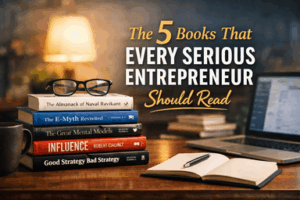

Yet when examined closely, most of the entrepreneurs who build durable businesses share one habit in common. They read consistently and intentionally.
This article is not a generic reading list. It is a focused guide to five books that shape how entrepreneurs think, decide, and operate over the long term. These books do not promise quick wins.
Instead, they influence judgment, discipline, and perspective. They help entrepreneurs make fewer costly mistakes and better long-term decisions. The goal is not to read more books. The goal is to read the right ones and apply what they teach.

Why Reading Still Separates Serious Entrepreneurs From Everyone Else
Busy Does Not Always Mean Informed
Many entrepreneurs pride themselves on being busy. Long hours, constant tasks, and endless problem-solving feel productive. However, activity does not guarantee improvement. Without deliberate learning, the same mistakes repeat in slightly different forms.
Reading introduces perspectives that are difficult to gain through experience alone. It compresses decades of insight into hours of focused attention.
Books Encourage Long-Term Thinking
Most online content focuses on short-term tactics. Algorithms reward urgency, trends, and novelty. Books work differently. They encourage reflection, patience, and structured thinking.
Books help entrepreneurs:
- See patterns across industries and time
- Understand cause and effect beyond surface results
- Develop principles instead of copying tactics
This type of thinking compounds over the years.
Reading as Leverage, Not Leisure
Serious entrepreneurs do not read to escape work. They read to sharpen how they approach it. One strong idea applied correctly can save years of trial and error.
Reading becomes leverage when:
- It improves decision quality
- It prevents avoidable mistakes
- It strengthens discipline under pressure
- It reframes how problems are viewed
Books as Always Available Mentors
Not every entrepreneur has access to experienced mentors. Books fill that gap. They provide access to the thinking of founders, investors, psychologists, and strategists who have faced similar challenges.
A book can be revisited during uncertainty, growth, or failure. Its value increases with experience.
Takeaway
Learning compounds like capital. Entrepreneurs who read consistently build an advantage that is quiet, durable, and difficult to copy.
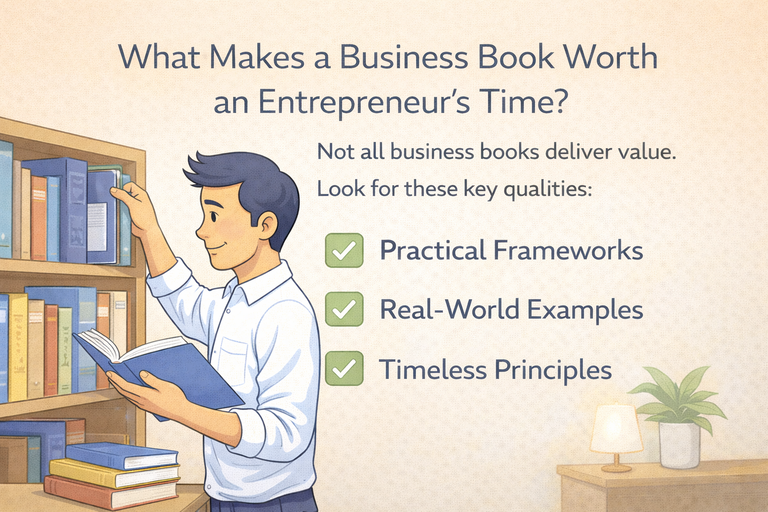
What Makes a Business Book Worth an Entrepreneur’s Time
Not All Business Books Are Equal
The business section is crowded. Many books promise transformation but deliver repetition. Serious entrepreneurs learn quickly that reading everything is not the goal. Discernment matters more than volume.
A good business book changes how you think. A poor one entertains without impact.
Core Qualities of High-Value Business Books
Strong business books usually share several characteristics.
Practical frameworks
They provide ways to think, not just stories. Frameworks help entrepreneurs analyze problems repeatedly in different situations.
Real-world examples
They draw from actual businesses, failures, and decisions. This grounds theory in reality.
Timeless principles
They remain relevant across industries and economic cycles. Their lessons do not expire when trends change.
Warning Signs of Low-Value Books
Entrepreneurs should approach certain books cautiously.
Common red flags include:
- Over-reliance on hype and urgency
- Promises of guaranteed results
- Heavy focus on shortcuts without fundamentals
- Trend-driven language tied to specific platforms or moments
These books often create excitement without substance.
Quality Over Quantity
| Quantity Focus | Quality Focus |
| Reading many books quickly | Reading fewer books deeply |
| Highlighting everything | Extracting core ideas |
| Seeking motivation | Seeking clarity |
| Consuming and moving on | Revisiting and applying |
Takeaway
One well-chosen book, applied seriously, can outperform dozens read casually.

Book 1: The Mindset Shift Every Entrepreneur Needs Early
The Almanack of Naval Ravikant
Why Mindset Comes Before Strategy
Before systems, tactics, or scale, mindset shapes every decision. Under pressure, entrepreneurs fall back on their default thinking patterns. This book addresses those patterns directly.
It focuses on responsibility, leverage, long-term thinking, and personal accountability. These ideas form the foundation of sound entrepreneurship.
How Mindset Shapes Decisions Under Pressure
When uncertainty increases, mindset determines behavior.
A strong mindset helps entrepreneurs:
- Stay rational during volatility
- Separate ego from outcomes
- Avoid panic-driven decisions
- Commit to long-term compounding
This book emphasizes building wealth through specific knowledge, patience, and ownership rather than speed or force.
Core Themes Entrepreneurs Absorb Over Time
- Discipline over motivation
- Long-term games with long-term people
- Responsibility as freedom
- Leverage through code, media, and judgment
These ideas influence how entrepreneurs structure work and life.
Founder Struggles and Personal Reflection
Many entrepreneurs relate to the internal struggle described throughout the book. The pressure to succeed quickly. The temptation to compare. The confusion between movement and progress.
The book does not offer formulas. It offers perspective. That perspective often shifts how founders evaluate success itself.

Book 2: Lessons From Business Systems and Scalability
The E-Myth Revisited
Why Systems Matter More Than Hustle
Many entrepreneurs build businesses that depend entirely on their personal effort. This creates exhaustion, inconsistency, and limited growth. This book explains why systems, not hard work alone, create scalable businesses.
It challenges the idea that technical skill equals business skill.
Core Concepts Introduced
The book introduces foundational ideas that many founders overlook.
Key concepts include:
- Businesses should work without the owner present
- Systems create consistency and reliability
- Documentation reduces chaos
- Roles matter even in small teams
Why Founders Skip Fundamentals
Founders often skip systems because:
- They feel unnecessary early on
- They seem boring compared to growth
- They appear restrictive
- They take time to design
However, skipping fundamentals leads to fragility later.
Long-Term Impact of System Thinking
Businesses built on systems:
- Scale more smoothly
- Experience less burnout
- Maintain quality as they grow
- Are easier to sell or step away from
This book shifts the entrepreneur’s role from operator to architect.

Book 3: Avoiding Costly Mistakes Through Better Thinking
The Great Mental Models
Why Decision Making Determines Long-Term Outcomes
Entrepreneurship is a series of decisions made under uncertainty. Some are small and frequent. Others are rare but high impact. Over time, the quality of these decisions compounds into either stability or chaos.
This book focuses on improving how entrepreneurs think, not what they think. It introduces mental models that help founders evaluate situations more clearly and avoid predictable mistakes.
How Poor Decisions Compound Quietly
Bad decisions rarely destroy a business immediately. Instead, they weaken it slowly.
Examples include:
- Hiring based on urgency instead of fit
- Expanding before stabilizing operations
- Chasing trends without understanding risks
- Ignoring second-order consequences
Each decision may seem reasonable in isolation, but together they create fragility.
Mental Models as Thinking Tools
Mental models are lenses for interpreting reality. They help entrepreneurs simplify complexity without oversimplifying truth.
Common models explored include:
- Opportunity cost
- Inversion
- Margin of safety
- Cause and effect thinking
- Probabilistic reasoning
These models improve judgment across marketing, hiring, strategy, and investment decisions.
Biases and Blind Spots
The book also explores cognitive biases that distort thinking.
Entrepreneurs are especially vulnerable to:
- Overconfidence
- Confirmation bias
- Availability bias
- Sunk cost fallacy
Recognizing these biases does not eliminate them, but it reduces their control over decisions.
Why This Book Changes Behavior Over Time
Unlike tactical books, this one becomes more valuable with experience. As entrepreneurs encounter new challenges, the mental models provide a stable framework for interpretation.
Better thinking leads to fewer regrets and more intentional growth.

Book 4: The Psychology Behind Customers and Teams
Influence
Businesses Succeed or Fail Because of People
At the core of every business are human decisions. Customers decide whether to trust. Employees decide how much effort to give. Partners decide whether to commit.
This book explains the psychological principles that shape those decisions.
Understanding Persuasion Without Manipulation
Persuasion is often misunderstood. Ethical persuasion is not deception. It is understanding how people naturally make decisions.
Key principles explored include:
- Reciprocity
- Commitment and consistency
- Social proof
- Authority
- Scarcity
When applied responsibly, these principles help entrepreneurs communicate more clearly and respectfully.
Why Trust Is the Real Currency
Trust determines:
- Conversion rates
- Retention
- Team morale
- Brand reputation
This book helps founders understand how trust is built and how easily it can be broken.
Practical Applications for Entrepreneurs
Entrepreneurs apply these ideas in many areas:
- Writing clearer marketing messages
- Designing onboarding experiences
- Leading teams with fairness and consistency
- Setting expectations transparently
Psychology improves outcomes not by force, but by alignment.

Book 5: Thinking Long Term Instead of Chasing Quick Wins
Good Strategy Bad Strategy
Why Long-Term Strategy Is Rare but Powerful
Many entrepreneurs operate reactively. They respond to trends, competitors, and short-term metrics. This creates movement without direction.
This book explains the difference between real strategy and vague ambition.
The Danger of Short-Term Thinking
Short-term thinking often leads to:
- Constant pivoting
- Scattered focus
- Weak positioning
- Burnout
Chasing quick wins undermines compounding advantages.
What Good Strategy Actually Looks Like
The book defines strategy as:
- Clear diagnosis of the problem
- A guiding policy for action
- Coherent actions aligned with that policy
This structure helps entrepreneurs cut through noise and focus resources effectively.
Linking Strategy to Real Entrepreneurial Journeys
Many successful entrepreneurs attribute longevity to patience and focus rather than speed. This book reinforces that sustainable success is built deliberately.
Strategic clarity reduces wasted effort and creates momentum over time.

How to Read Business Books Without Turning Them Into Shelf Decoration
Why Many Entrepreneurs Read Without Applying
Reading alone does not create change. Consumption without action leads to intellectual clutter.
Many entrepreneurs highlight ideas but never integrate them into behavior.
Practical Reading Habits That Work
Effective readers approach books differently.
Helpful habits include:
- Taking notes in your own words
- Writing short summaries after each chapter
- Identifying one idea worth testing
- Connecting ideas to current challenges
One Idea Implementation Rule
Instead of trying to apply everything, focus on one meaningful insight.
This prevents overwhelm and increases retention.
Revisiting Books as Experience Grows
Books reveal different lessons at different stages. Revisiting them allows a deeper understanding.
A book read early often makes more sense later.
Takeaway
Application transforms reading from entertainment into leverage.

What Serious Entrepreneurs Do Differently With What They Read
Reading With Intent
Serious entrepreneurs do not read passively. They read with purpose.
They ask:
- How does this apply to my situation
- What assumption does this challenge
- What decision does this improve
Reflection and Discussion
Ideas become clearer when discussed. Entrepreneurs who talk through what they read gain perspective and accountability.
Discussion surfaces blind spots and strengthens understanding.
Building a Personal Knowledge System
Instead of scattered notes, serious entrepreneurs organize insights.
Examples include:
- Personal frameworks
- Digital note systems
- Decision journals
- Idea libraries
This turns reading into a long-term asset.
Takeaway
Deliberate learning compounds faster than casual consumption.

Final Thoughts on Books as Silent Business Partners
Entrepreneurship is shaped by how decisions are made over time. The books discussed in this article do not promise shortcuts or instant results. Instead, they strengthen the thinking behind every action an entrepreneur takes.
Mindset determines resilience. Systems create stability. Better thinking reduces costly mistakes. Psychology improves communication and trust. A long-term strategy keeps effort aligned with meaningful goals.
Together, these ideas guide entrepreneurs through uncertainty with greater clarity. Books act as silent business partners. They offer perspective when pressure is high and judgment is clouded. They remind founders that others have faced similar challenges and found ways forward.
Serious entrepreneurs do not read to escape work. They read to do it better. Over time, that difference shapes businesses that last.