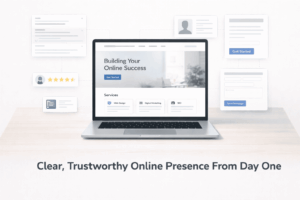

When you build a strong online presence from day one, you make every other part of the business easier. Your marketing gets cheaper over time. Your sales calls feel smoother. Your referrals convert faster. And you stop losing good opportunities just because your online footprint looks unclear.

This guide will show you what “strong” really means, what to set up first, what to post, what to ignore, and a simple plan you can follow without burning your time.
Let me make “online presence” simple, because most people overcomplicate it

A strong online presence is not about being everywhere. It is not about daily posts. It is not about looking like an influencer.
It is about this:
When the right person checks you out, they quickly understand who you help, what you do, how you work, what results you aim for, and how to take the next step.
Here are the three jobs your online presence must do.
- Clarity: People understand your offer without guessing.
- Trust: People feel safe enough to reach out.
- Momentum: Your content and profiles keep working even when you are busy.
If those three jobs happen, you are in good shape. If one of them fails, the leaks will lead out.
Start with the basics that make you look real, even if you are brand new

Most new businesses do not lose customers because the service is bad. They lose customers because the online footprint feels incomplete.
A buyer thinks, “If this looks messy, what else will be messy?” It is not fair, but it is real.
Here is a quick table I use with clients who want clarity.
| Asset | Why it matters | What “good enough” looks like |
| Website homepage | Sets the first impression | Clear offer, who it is for, next step |
| Contact page | Removes friction | Form plus email, simple and clean |
| Business email | Builds credibility | Yourname at yourdomain |
| One primary profile | Helps people verify you | Updated photo, short bio, link to site |
| Proof section | Reduces doubt | Testimonials, results, samples, or screenshots |
You can build this in a weekend if you focus. You do not need a perfect design. You need clear information and consistent signals.
Your website is your home base, so treat it like one
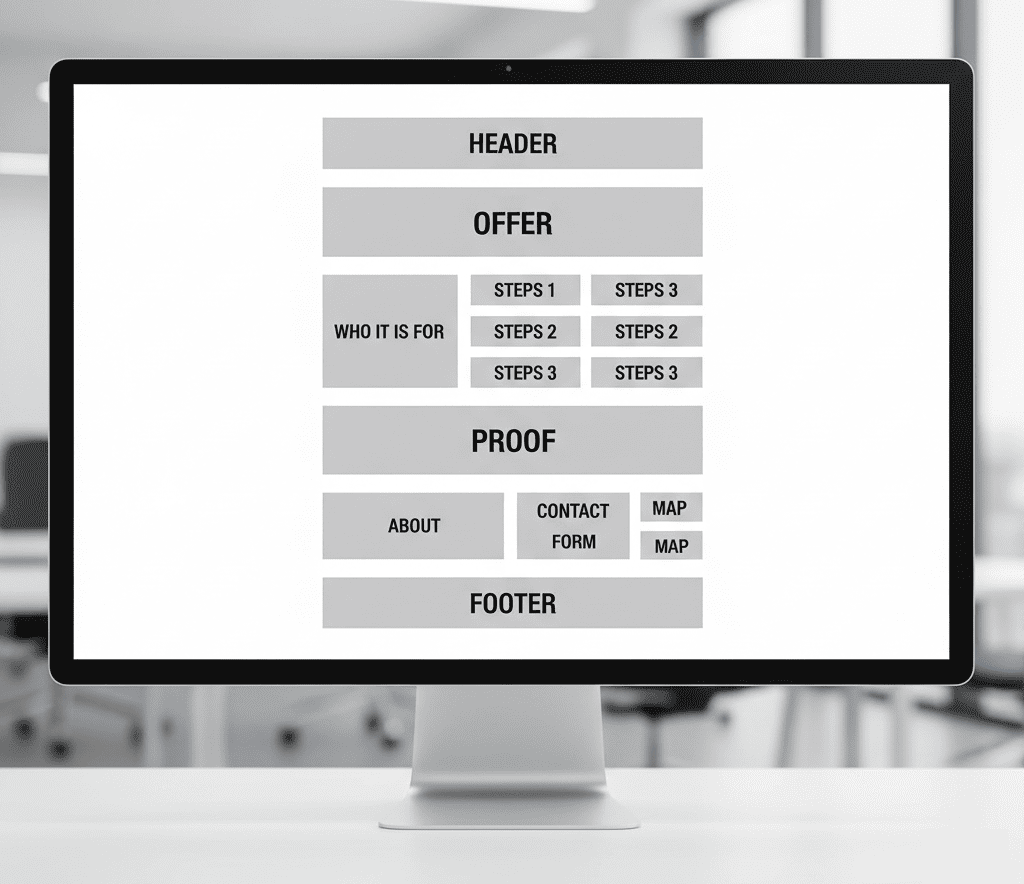
Social platforms change all the time. Algorithms shift. Accounts get restricted. Trends move. That is normal. Your website is the only place you control.
From day one, your website should do four things.
- Say what you do in plain language: Avoid vague lines like “We provide solutions.” Tell me what you do.
- Call out who you help: The more specific you are, the easier it is for the right people to feel seen.
- Show your process: A simple step 1, step 2, step 3 removes anxiety.
- Tell people what to do next: Contact, book a call, request a quote, download a guide, or join your email list.
If you sell products or digital offers, you can still follow the same flow. You just adjust the proof and the call to action.
Consistency matters more than creativity

A weak online presence often has one problem: mixed signals.
Different names on different platforms. Different services are listed in different places. Old photos. Old offers. Old links. It creates friction.

I want you to pick your core message and repeat it everywhere. This is not boring. This is branding.
Here is a simple consistency checklist.
- Same business name everywhere
- Same core service wording everywhere
- Same main link everywhere
- Same profile photo everywhere
- Same tone everywhere
You do not need a big brand guide on day one. You need alignment.
If you want a fast test, ask yourself this:
If someone lands on your website, then clicks your profile, then reads one post, do they still feel like they are in the same world?
If the answer is yes, you are winning.
Content is not a performance. It is a service.

Most people approach content like they are trying to impress strangers. That is why they freeze.
I want you to approach content like this.
Every post, every page, every article is a helpful answer to a real question a buyer already has.
That shift changes everything. It lowers pressure. It raises quality. It attracts the right people.
The questions that create the best content
- “What should I do first?”
- “How much does this cost?”
- “How long does this take?”
- “What mistakes should I avoid?”
- “How do I know this is right for me?”
- “What does success look like?”
When you answer those questions publicly, you reduce confusion and you increase trust.
Here is a content mix that works well from day one.
- One long article per week
A helpful guide that answers one main problem. - Two to four short posts per week
Lessons, tips, examples, quick stories. - One proof post per week
Result, testimonial, behind the scenes, before and after.
You can do less if time is tight. You just need consistency.
Social media is not required, but it is useful if you use it with a plan

Some people build a strong presence with a website and email only. That is fine.
But social media can help you in two ways.
It helps people verify you. It helps you stay top of mind.
The mistake is trying to do five platforms. That drains you.
I prefer one primary platform at first. If your work is service-based or coaching, a professional platform can do a lot. If your work is visual, a visual platform can do a lot. You do not need to be everywhere.
Here is a simple table that helps you decide.
| Platform type | Best for | What to post the most |
| Professional network | Services, coaching, consulting | Helpful lessons, proof, process |
| Visual platform | Products, design, fitness, food | Before and after, demos, stories |
| Video platform | Teaching and building trust fast | Short tips, mini lessons, FAQs |
| Community platform | Niche audiences | Real answers, discussion, support |
Your goal is not fame. Your goal is clear trust signals.
Proof matters, and you can build it even when you do not have many clients yet

Proof reduces risk in the buyer’s mind. It answers the quiet question: “Will this work for me?”
A lot of people wait to build proof. That slows growth.
Proof you can use right now
- Testimonials
If you have them, use them. Keep them specific. - Screenshots of results
Numbers, before and after, milestones. - Case studies
A simple story: problem, what you did, result. - Samples
A sample project, a demo, a walkthrough. - Mini wins
Even small outcomes can show competence if you explain them well.
If you are at the very beginning, you can do a few discounted projects to build early proof. Just be clear about boundaries. Do not trap yourself in low-price work forever.
Time Management for a Polished, Balanced Presence

A strong online presence does not require you to live on the internet. It requires a system.
Here is the system I teach.
Use a simple weekly rhythm
- One planning block
30 to 45 minutes. Decide what you post and what you write. - One content creation block
2 to 3 hours. Write one article or record one main video. - One repurpose block
60 minutes. Pull three to six short posts from the main piece. - One proof block
15 minutes. Share a result, a lesson, or a behind-the-scenes.
That is enough for most businesses.
If you try to create from scratch every day, you will burn out. If you build around one main piece per week, you stay consistent.
Here is a way to repurpose one article.
- Turn the introduction into one short post.
- Turn the main steps into two short posts.
- Turn the mistake section into one short post.
- Turn the conclusion into one email.
You get a full week of content without chaos.
Common mistakes that weaken your online presence, even when you work hard

I see these all the time.
Mistake 1: You talk about yourself more than the buyer’s problem
People care about themselves first. Lead with the problem you solve.
Mistake 2: Your offer sounds vague
Words like “solutions” and “support” do not help. Say what you do.
Mistake 3: You split attention across too many platforms
Pick one main platform. Do it well. Add the next one later.
Mistake 4: You post tips, but you never show proof
Tips build interest. Proof builds trust. You need both.
Mistake 5: Your next step is unclear
Do not make people guess. Tell them what to do next.
If you fix these, your presence gets stronger without more effort.
A simple 30-day plan that builds a strong presence

If you want something practical, use this.
Week 1: Foundation
- Set up your website homepage and contact page
- Set up a business email
- Update one primary profile
- Write a short about section
- Add one clear call to action
Week 2: Core pages
- Add services page
- Add pricing or starting price
- Add FAQ page
- Add a proof section, even if it is small
- Add a simple process section
Week 3: Content that answers buyer questions
- Write one main article that solves a common problem
- Publish three short posts from that article
- Send one email to your list or start your list
Week 4: Proof and momentum
- Publish one case study or sample breakdown
- Publish one behind-the-scenes post that shows how you work
- Improve one page based on the questions you get
- Repeat the weekly rhythm
At the end of 30 days, you will not just “exist online.” You will look clear, active, and trustworthy.
How do you know your online presence is getting stronger?

Do not overthink metrics early. Track what matters.
- More people reply, not just like
- Better questions from leads
- Shorter time from first contact to decision
- More referrals that convert
If you want a simple weekly check, use this.
- Did I publish one helpful piece this week?
- Did I show proof this week?
- Did I make it easy for someone to contact me this week?
If you keep that up, you will build a presence that lasts.
The real point of day one presence is this: You build trust before you need it
Most people start building their presence when they feel stuck. That is late. At that point, you feel pressure, and pressure leads to rushed decisions.
When you build your online presence from day one, you give yourself breathing room. You create a steady flow of trust signals. You make your business easier to find, easier to understand, and easier to say yes to.
You do not need to look famous. You need to look clear, consistent, and real.